
The Delhi Court bail process is one of the most important safeguards in the criminal justice system. It ensures that an accused person can remain free while awaiting trial, provided they comply with the terms set by the court. Bail is not a loophole to escape justice; instead, it is a legal right that upholds the constitutional principle that a person is presumed innocent until proven guilty.
In Delhi, the courts follow the Criminal Procedure Code (CrPC), but each case is evaluated on its unique facts. A criminal lawyer plays a vital role in guiding clients through this process, from drafting a legally sound bail application to presenting persuasive arguments before the judge. Without professional help, the chances of delay or outright rejection can increase significantly.
The key principle behind bail in Delhi is: “Bail is the rule, jail is the exception.” However, courts will deny bail if there’s a high risk of the accused absconding, influencing witnesses, or committing further offences.
Understanding Bail in Indian Legal System
Bail is a legal mechanism that allows an accused person to be temporarily released from custody in exchange for a surety or bond, ensuring their presence at trial. It is a balance between two competing interests: the right of the accused to liberty and the need to ensure justice is served.
In the Indian legal framework, there are two categories of offences:
- Bailable Offences – Bail must be granted once surety is provided.
- Non-Bailable Offences – Bail is subject to the discretion of the court.
In Delhi, the criminal courts deal with thousands of bail applications each year. Magistrate courts handle bailable and less serious non-bailable offences, while Sessions Courts and the Delhi High Court take up complex or high-profile bail matters.
A good criminal lawyer in Delhi ensures that the bail application highlights weaknesses in the prosecution’s case, shows the accused’s cooperation with authorities, and demonstrates that granting bail would not harm public interest.
What is Bail and Why is it Important?
Bail is conditional freedom granted to an accused person until their trial concludes. The main objectives are:
- To uphold the presumption of innocence – The law does not treat an accused as guilty until proven so.
- To protect personal liberty – Unnecessary imprisonment before trial violates human rights.
- To allow preparation for defence – Being free helps the accused consult lawyers, gather evidence, and attend to personal responsibilities.
Without bail, even individuals accused of minor offences could spend months in jail, especially in cases where trials are delayed due to a backlog in Delhi courts. This is why criminal lawyers stress that bail is not a privilege but a fundamental right for those eligible.
Types of Bail in Delhi Court
Delhi courts recognize three main types of bail:
- Regular Bail – Sought after an arrest and custody.
- Anticipatory Bail – Applied for before arrest if there’s fear of detention.
- Interim Bail – Temporary relief until a decision on the main bail plea is made.
Each has specific conditions and procedures. Choosing the correct type depends on the stage of the criminal case, the seriousness of the offence, and the available evidence.
Regular Bail Explained
Regular bail is granted after a person has been arrested and is in judicial custody. In Delhi, the process begins with filing an application under Section 437 CrPC before a Magistrate or under Section 439 CrPC before a Sessions Court or the High Court, depending on the case.
Criminal lawyers use this stage to argue for release based on:
- Weak evidence.
- Delay in investigation.
- The accused’s clean record.
- Humanitarian reasons (age, health, dependents).
A successful regular bail application allows the accused to remain free for the duration of the trial, subject to conditions.
Anticipatory Bail Explained
Anticipatory bail under Section 438 CrPC is preventive in nature. It is sought before arrest in non-bailable cases where the accused fears detention. In Delhi, such applications are usually made to the Sessions Court or Delhi High Court.
Courts consider:
- The seriousness of allegations.
- Whether the accused is cooperating with investigation.
- Any previous criminal record.
If granted, anticipatory bail prevents the police from arresting the accused, although the court may still impose strict conditions.
Interim Bail Explained
Interim bail is temporary relief given while a regular or anticipatory bail application is pending. It’s often used when there is an urgent need to avoid arrest before the main bail hearing.
In Delhi courts, interim bail typically lasts a few days to a few weeks and can be extended if necessary. A criminal lawyer uses it strategically to protect the client from custody while preparing a stronger long-term bail plea.
The Role of a Criminal Lawyer in Bail Cases
A criminal lawyer is more than just a paperwork handler. They:
- Examine the FIR for inconsistencies.
- Identify legal grounds for bail.
- Collect and present supporting evidence.
- Anticipate and counter prosecution arguments.
In Delhi, where courtrooms are busy and judges expect precision, the drafting and presentation of the bail application can make or break the case.
Bail Process in Delhi Court Step-by-Step
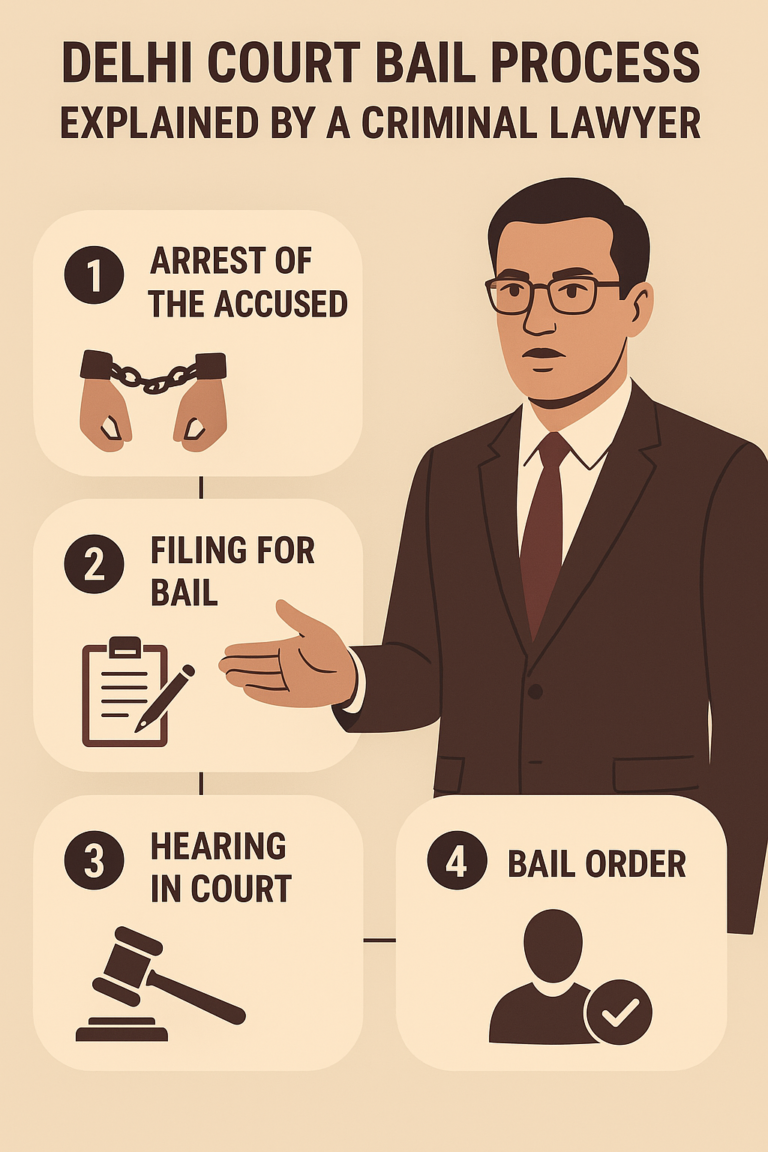
The bail process in Delhi courts follows a structured sequence, though timelines can vary based on case urgency and court workload. Below is a detailed breakdown:
- Consulting a Criminal Lawyer – The first step is seeking expert advice to assess the strength of your case, the type of bail needed, and the best legal approach.
- Drafting the Bail Application – The lawyer prepares an application citing relevant legal sections, facts, and precedents that support the plea.
- Attaching Necessary Documents – This includes the FIR copy, ID proofs, surety documents, and any medical or humanitarian grounds.
- Filing in the Correct Court – Applications for bailable offences usually go to Magistrate Courts, while serious cases go to Sessions Courts or the Delhi High Court.
- Court Hearing – The judge hears arguments from both the defence and prosecution.
- Court’s Decision – The judge grants or rejects bail, often with conditions attached.
An experienced lawyer ensures that no procedural step is missed and that the application is both legally sound and persuasive.
Filing a Bail Application
Filing a bail application in Delhi requires precision. The application must clearly mention:
- The accused’s details.
- The nature of the offence.
- The stage of the case (investigation/trial).
- Legal grounds for bail.
- Assurances of cooperation with the court.
A well-drafted application avoids unnecessary legal jargon and presents the facts in a straightforward manner. Judges appreciate clarity, brevity, and proper legal citations.
Documents Required for Bail Application in Delhi
Commonly required documents include:
- FIR copy.
- Arrest memo (if applicable).
- ID proof of the accused.
- Proof of address.
- Surety documents.
- Any medical certificates (if bail is sought on health grounds).
Providing all documents upfront avoids delays and strengthens credibility before the court.
Factors Considered by Delhi Courts While Granting Bail
Judges in Delhi weigh several factors before granting bail:
- Nature of the offence – Serious crimes face stricter scrutiny.
- Criminal history – Repeat offenders find it harder to get bail.
- Likelihood of absconding – The accused must prove they won’t flee.
- Risk to witnesses or evidence – Bail may be denied if there’s a chance of tampering.
Legal Grounds for Granting Bail
Some effective legal grounds include:
- Lack of prima facie evidence.
- Delays in trial.
- Health concerns.
- Being a first-time offender.
- Strong community ties ensuring the accused won’t abscond.
Common Reasons for Bail Rejection in Delhi
Courts reject bail if:
- The offence is extremely serious (e.g., terrorism, murder).
- There’s a high risk of the accused committing more crimes.
- Witnesses could be threatened.
- The accused has a history of non-appearance in court.
Bail in Bailable Offences
In bailable offences, bail is a right under Section 436 CrPC. Once surety and bond requirements are met, the court must grant bail. This category usually includes minor thefts, simple assaults, and petty fraud cases.
Bail in Non-Bailable Offences
In non-bailable offences under Section 437 and 439 CrPC, the court has full discretion. Here, the skill of a criminal lawyer is critical in persuading the court.
Urgent Bail Hearings in Delhi Courts
For medical emergencies, risk of immediate arrest, or humanitarian reasons, lawyers can request an urgent bail hearing. The Delhi courts often accommodate urgent listings if justified.
Conditions Imposed During Bail
Bail usually comes with conditions like:
- Not leaving Delhi without permission.
- Attending all court hearings.
- Avoiding contact with witnesses.
- Reporting to the police periodically.
Rights of the Accused After Bail
Once bail is granted, the accused can:
- Resume work.
- Travel within the permitted area.
- Prepare for trial with full legal access.
However, they must strictly follow bail conditions or risk cancellation.
Bail Cancellation Process in Delhi
If the accused violates bail conditions, the prosecution can apply for cancellation under Section 439(2) CrPC. Courts take violations seriously, and bail may be revoked immediately.
How a Criminal Lawyer Strengthens Your Bail Plea
A skilled lawyer:
- Drafts a legally tight application.
- Uses case precedents in your favour.
- Highlights humanitarian grounds.
- Counters prosecution claims effectively.
Practical Tips for a Successful Bail Application
- Hire an experienced criminal lawyer early.
- Prepare all documents beforehand.
- Maintain a respectful and cooperative approach with authorities.
Case Studies of Bail in Delhi Courts
For example, in State vs. Ramesh (2021), the Delhi High Court granted bail on grounds of prolonged trial delays, setting a precedent for similar cases.
Delhi High Court vs. District Court Bail Jurisdiction
- District Courts – Handle most regular and urgent bail cases.
- Delhi High Court – Handles complex legal issues, high-profile cases, and anticipatory bail in sensitive matters.
Recent Trends and Changes in Bail Laws in Delhi
Recent judgments favour bail in economic offences unless serious risk factors exist, while still being strict in violent crime cases.
Conclusion
The Delhi Court bail process is a lifeline for accused individuals, safeguarding liberty while ensuring justice. With the expertise of a criminal lawyer, one can navigate the complexities, avoid procedural mistakes, and present a strong case for release. The key lies in early legal action, thorough documentation, and respectful court conduct.

Frequently Asked Questions.
From a few hours to several days, depending on urgency.
Yes, if there is reasonable apprehension of arrest
You can appeal to a higher court.
Mostly yes, but sometimes a personal bond is enough.
Yes, through a modification application.
No, it only means temporary release until the trial ends.