
Every legal system rests on the foundation of fairness. And at the heart of fairness lies proper delivery of legal documents. From civil suits to criminal trials, from tax demands to corporate notices, the service of documents ensures that no individual or entity is ambushed by proceedings without a chance to defend themselves.
Delivery is not just a technical step it is a safeguard of due process. Yet, disputes often arise when innovative or alternative methods like examining service notices are used. The question then becomes: should such methods be recognized as proper service, or do they undermine the principle of fairness?
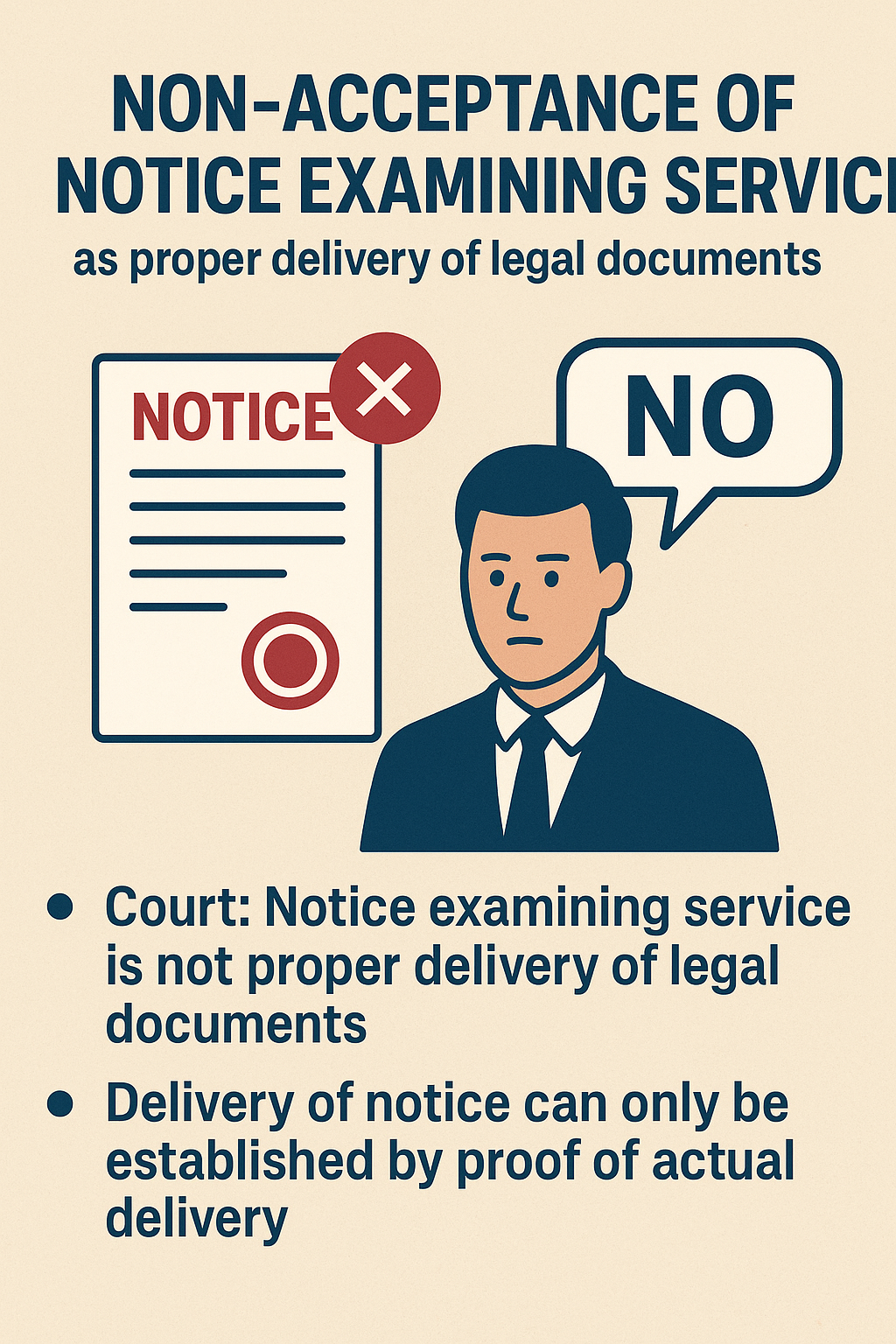
Non-Acceptance of Notice Examining Service as Proper Delivery of Legal Documents
The debate over non-acceptance of notice examining service as proper delivery is not merely academic. It has real-world consequences trials delayed, tax assessments quashed, and regulatory orders set aside.
An examining service notice refers to a method where documents are sent through systems that claim to authenticate receipt (often digital). However, if the recipient challenges the service, the legal system must determine whether this method qualifies as proper delivery under statutory requirements.
Thus, non-acceptance is a safeguard against potential misuse, ensuring that the right to be heard is never compromised.
The Role of Notice in Legal Proceedings
Notice serves as the legal system’s way of saying: “You are entitled to know what is being alleged, and you have the right to respond.”
It fulfills three essential purposes:
- Information: Communicates claims or charges.
- Opportunity: Provides time to prepare a defense.
- Legitimacy: Protects the authority of the legal process itself.
If a notice is not properly delivered, the entire proceeding risks being invalidated no matter how strong the underlying case may be.
Traditional Methods of Serving Legal Documents
For centuries, courts relied on time-tested delivery mechanisms:
- Personal service – physically handing documents to the individual.
- Registered post with acknowledgment – requiring the recipient’s signature.
- Newspaper publication – used when the recipient was untraceable.
These methods had one thing in common: verifiable proof of service. Courts accepted them because they ensured certainty and fairness.
Emergence of Examining Service Notices
In the digital era, efficiency became a priority. Governments, courts, and businesses began experimenting with examining service notices digital platforms that send, track, and verify delivery electronically.
For instance:
- Tax authorities using online dashboards.
- Corporate registrars sending compliance alerts.
- Courts adopting e-filing and digital summons.
While faster, these methods sometimes fall short of statutory recognition, creating room for disputes.
Why Non-Acceptance of Notice Examining Service Raises Concerns
Courts are cautious for several reasons:
- Authentication doubts – Can the sender prove the exact recipient viewed the notice?
- Digital divide – Many individuals, especially in rural or underprivileged areas, may lack digital access.
- Tampering risks – Electronic systems are vulnerable to hacking or manipulation.
Thus, while convenient, examining service notices may compromise fairness if accepted without scrutiny.
Judicial Views on Proper Delivery of Legal Documents
Judiciaries across jurisdictions have consistently held:
- Proper service is mandatory before any adverse order.
- Doubt favors the recipient—if service is questionable, courts lean toward non-acceptance.
- Precedents matter—landmark judgments guide future cases.
For example, the Indian Supreme Court has repeatedly emphasized that mere uploading of notices online does not constitute valid service unless expressly permitted by statute. Similar trends appear in U.S. and U.K. courts.
Statutory Provisions Governing Notice Delivery
Different laws across countries outline what constitutes valid service:
- Civil Procedure Codes mandate personal or registered post service.
- Taxation statutes often require physical or electronic acknowledgment.
- Corporate laws specify delivery at the registered address.
When statutes are silent about examining service, courts often refuse to accept it as proper delivery.
The Principle of Natural Justice
One of the oldest legal maxims “Audi alteram partem” (hear the other side) makes proper service indispensable. If notice is not duly served, natural justice is violated, and proceedings may collapse.
Thus, non-acceptance acts as a safeguard of this timeless principle.
Digital Transformation in Legal Notices
Despite concerns, digital service of notices is gaining traction. Courts in several countries have accepted:
- Email notices with read receipts
- WhatsApp service with double-tick confirmation
- Court dashboards where litigants log in
Yet, this acceptance is conditional there must be proof of actual receipt, not just sending.
Examining Service vs Proper Service
Feature | Examining Service | Proper Service |
Mode | Digital/third-party platforms | Physical/personal or statutory digital |
Proof | System-generated acknowledgment | Signed receipt or statutory compliance |
Legal acceptance | Often disputed | Universally recognized |
Risk | High chance of challenge | Minimal challenge |
This distinction highlights why courts are reluctant to equate the two.
Case Studies on Non-Acceptance of Notice Examining Service
- Corporate law cases – Notices sent via email without acknowledgment were invalidated.
- Tax law disputes – Assessments were set aside where notices were only uploaded on digital portals.
- Criminal summons – Courts rejected examining service methods lacking personal acknowledgment.
These cases illustrate the judicial insistence on strict compliance with service rules.
Rights of the Recipient in Legal Notices
Recipients have the right to:
- Refuse improper service
- Demand statutory compliance
- Challenge proceedings initiated without proper notice
This ensures that justice is never sacrificed at the altar of convenience.
Duty of the Issuer of Notices
Authorities, lawyers, and businesses issuing notices must:
- Use legally recognized delivery methods.
- Maintain proof of service.
- Ensure accessibility to recipients.
Failure to comply risks nullifying entire proceedings.
Consequences of Improper Service of Notices
When service is not proper, consequences include:
- Proceedings declared null and void.
- Orders set aside by appellate courts.
- Loss of time, money, and credibility for the issuer.
Thus, non-acceptance protects both fairness and efficiency in the long run.
How Courts Determine Proper Delivery
Courts apply specific tests:
- Was the notice delivered at the right address/person?
- Was there acknowledgment or proof of refusal?
- Was the method used permitted by law?
If these conditions fail, service is considered improper.
The Burden of Proof in Service of Notice
The law places the burden on the issuer of the notice, not the recipient. The sender must prove:
- Delivery was attempted in compliance with law.
- Proof exists to show receipt or refusal.
This prevents misuse and protects recipients from unfair surprise.
International Perspectives on Legal Notice Delivery
- United States – Federal Rules of Civil Procedure recognize personal and certified mail service. Electronic service is accepted only with consent.
- United Kingdom – Courts allow email and electronic filing, but with strict acknowledgment rules.
- India – Courts have cautiously accepted WhatsApp/email but only with clear proof.
Globally, the trend is toward acceptance of technology but never at the cost of fairness.
Role of Technology in Authenticating Notices
Emerging tools like blockchain and digital signatures may resolve disputes by ensuring:
- Immutable proof of sending and receiving.
- Timestamp verification.
- Reduced manipulation risks.
These innovations could bridge the gap between examining service and proper service.
Challenges in Rural and Remote Areas
Digital delivery may work in urban centers, but in rural or remote areas:
- Internet access is limited.
- Recipients may lack digital literacy.
- Physical service remains the only reliable option.
Thus, courts hesitate to fully replace traditional methods.
Preventive Measures Against Disputes in Notice Delivery
Best practices include:
- Sending through multiple modes (post + email).
- Maintaining video or photographic proof of delivery attempts.
- Using statutorily recognized platforms only.
These steps minimize disputes and ensure smoother proceedings.
Future of Legal Document Delivery Systems
The future may see:
- AI-powered tracking of notices.
- Smart contracts ensuring automatic delivery.
- Integration of national identity systems for digital acknowledgment.
Yet, the human element of fairness will always remain central.
Non-Acceptance of Notice Examining Service in Corporate Law
In corporate disputes, improper service can:
- Invalidate shareholder meetings.
- Nullify compliance filings.
- Delay mergers or acquisitions.
Thus, strict adherence to statutory service is vital.
Non-Acceptance of Notice Examining Service in Tax Law
Tax authorities often rely on online portals. However, courts have ruled that mere uploading of a notice is not enough it must be communicated properly. Otherwise, tax assessments are quashed.
Best Practices for Lawyers and Litigants
- Always use recognized modes of delivery.
- Collect acknowledgment or refusal proof.
- Advise clients about risks of improper service.
Proactive compliance saves time, money, and credibility.
Conclusion
The non-acceptance of notice examining service as proper delivery of legal documents is not about clinging to outdated practices it is about protecting justice. Proper service is the lifeline of fairness, ensuring no individual or business faces legal action without knowledge and opportunity to respond.
As technology advances, examining services may eventually meet the standards of due process. Until then, courts and lawmakers must tread carefully, balancing efficiency with fairness, because justice delayed may be bad but justice denied is worse.

Frequently Asked Questions.
Because it safeguards the principle of natural justice, ensuring fairness.
Yes, but only when expressly permitted by statute and backed by proof of acknowledgment.
No. Courts often halt proceedings until proper service is established.
Refusal is usually considered valid service, provided statutory procedures are followed.
Not unless the recipient is proven to have accessed it, or law specifically permits it.
Yes, if laws evolve to recognize it and strong safeguards ensure fairness.