
The International Criminal Court (ICC) plays a central role in the global fight against crimes against humanity and war crimes. Established in 2002 through the Rome Statute, the Court became the first permanent international tribunal with jurisdiction over the gravest crimes of concern to the international community. Its creation marked a turning point in global justice, building upon the legacy of Nuremberg and Tokyo trials and later ad hoc tribunals for Rwanda and Yugoslavia.
The ICC aims to ensure that no perpetrator of mass atrocities enjoys impunity, regardless of rank or status. It provides a platform for justice when national courts are unable or unwilling to act. While controversial at times, the Court remains a symbol of humanity’s determination to pursue justice for the most egregious crimes.
Understanding Crimes Against Humanity and War Crimes
Crimes against humanity and war crimes are distinct but closely related. Crimes against humanity involve widespread or systematic attacks against civilian populations, such as murder, torture, and enslavement. War crimes, by contrast, are serious violations of the Geneva Conventions, including targeting civilians, using child soldiers, or employing prohibited weapons.
History has witnessed shocking examples, from the Holocaust to atrocities in Rwanda, Bosnia, and Darfur. These tragedies highlighted the urgent need for a permanent institution to prosecute such acts. The ICC provides a legal mechanism to address these crimes, ensuring perpetrators are brought to justice.
The Role of International Criminal Court in Combating Crimes Against Humanity and War Crimes
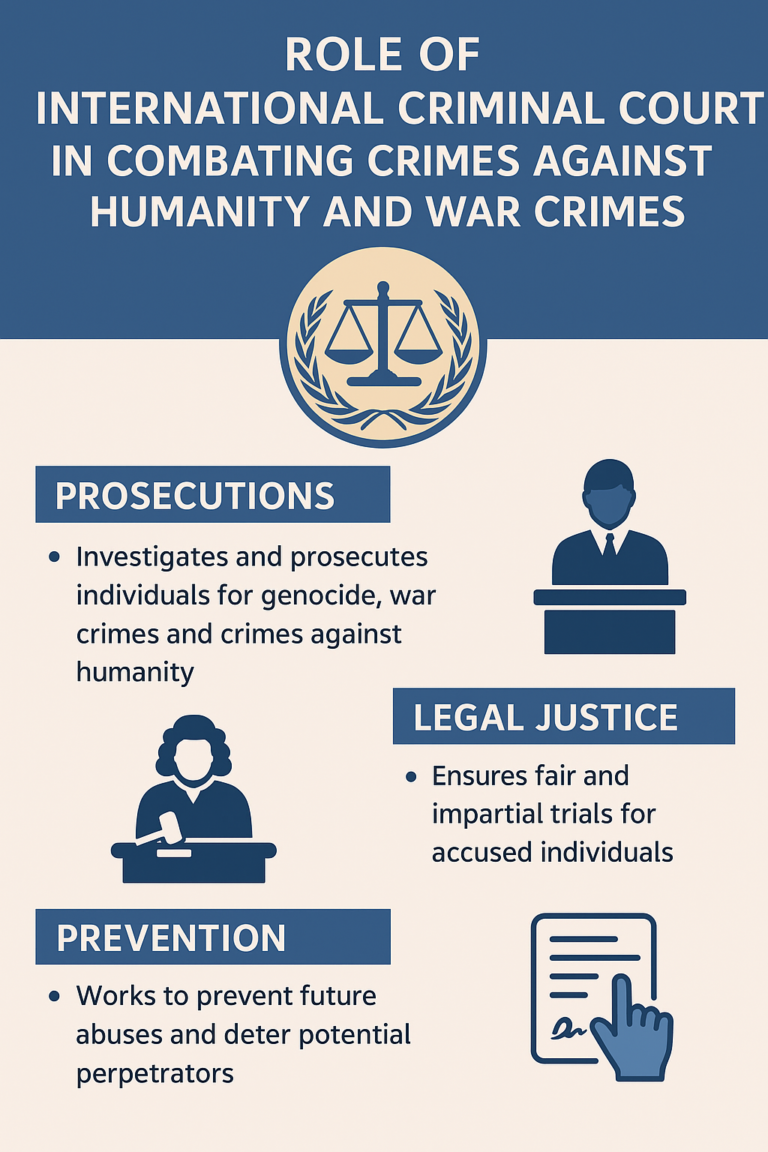
The ICC is tasked with investigating and prosecuting individuals accused of the most serious international crimes. Its jurisdiction extends to crimes against humanity, war crimes, genocide, and aggression, provided the alleged crimes occurred in a member state or were referred by the UN Security Council.
Through its legal framework, the ICC carries out independent investigations, issues arrest warrants, and conducts trials. Its rulings send a powerful message that international law is not an abstract concept but a living shield for victims of brutality.
The Principle of Complementarity
One of the ICC’s guiding principles is complementarity, meaning the Court only intervenes when national jurisdictions are unwilling or unable to prosecute. This framework respects state sovereignty while ensuring accountability.
By complementing domestic legal systems, the ICC encourages states to strengthen their own judicial institutions, fostering a culture of accountability rather than replacing local courts.
Landmark ICC Cases on War Crimes and Crimes Against Humanity
The ICC has presided over several landmark cases. The conviction of Thomas Lubanga Dyilo in 2012 for recruiting child soldiers marked the Court’s first verdict. Later, Bosco Ntaganda, known as “The Terminator,” was convicted of war crimes and crimes against humanity in the Democratic Republic of Congo.
These cases demonstrated the Court’s capacity to prosecute high-level perpetrators and gave victims a chance to see justice served. They also set important legal precedents for future cases.
Challenges Facing the International Criminal Court
Despite its achievements, the ICC faces significant obstacles. Many powerful countries, including the United States, Russia, and China, are not parties to the Rome Statute. This limits the Court’s jurisdiction and hinders enforcement.
Political interference also undermines the ICC’s effectiveness. Arrest warrants are often ignored, and some leaders portray the Court as biased. Additionally, limited resources constrain the Court’s ability to investigate complex crimes across multiple regions.
Criticism and Controversies Surrounding the ICC
The ICC has faced accusations of bias, particularly its focus on African cases. Critics argue this selective approach undermines the Court’s legitimacy. Others claim that Western nations exert disproportionate influence, raising questions about neutrality.
Nonetheless, defenders argue that African leaders themselves referred many cases, and the Court continues to expand its reach to other regions.
Success Stories of the ICC in Promoting Justice
Despite criticism, the ICC has achieved notable successes. It has delivered justice for victims, created a historical record of atrocities, and deterred future crimes by signaling accountability. In some cases, the Court has reinforced fragile states’ rule of law by encouraging domestic prosecutions.
The ICC also empowers victims, granting them participation in trials and reparations. This human-centered approach distinguishes the ICC from past tribunals.
The Role of Victims in ICC Proceedings
Victims play an essential role in ICC proceedings. They are not passive observers but active participants who can present views and concerns during trials. The Court also provides reparations, including psychological support, compensation, and community rebuilding initiatives.
Such mechanisms help restore dignity to survivors and strengthen the belief that justice is attainable.
The ICC’s Relationship with the United Nations
The ICC maintains a strong link with the UN Security Council, which can refer cases even from non-member states, as seen in Darfur and Libya. Collaboration with other UN agencies enhances investigations and protection of witnesses.
This partnership highlights how global institutions can work together to fight impunity.
International Cooperation in Prosecuting War Crimes
For the ICC to succeed, international cooperation is crucial. Extradition treaties, enforcement of arrest warrants, and assistance from NGOs all play vital roles. Civil society organizations often provide evidence and advocate for victims, making them indispensable partners of the Court.
Technological Advancements in ICC Investigations
Modern technology has transformed ICC investigations. Digital evidence, satellite imagery, and social media data have become critical in documenting atrocities. Emerging tools like AI-driven forensic analysis are revolutionizing how crimes are investigated and prosecuted.
These innovations enhance accuracy and efficiency, strengthening the credibility of prosecutions.
The ICC and the Fight Against Impunity
By holding individuals accountable, the ICC undermines the culture of impunity. Leaders now know that they may face international justice if they commit atrocities. This deterrent effect, while difficult to measure, reinforces the global rule of law.
Future of the ICC in Combating War Crimes
The future of the ICC depends on reforms to enhance efficiency, strengthen cooperation, and secure funding. Expanding membership and building trust among states are also essential.
With greater support, the ICC can continue to stand as a beacon of international justice, ensuring no crime goes unpunished.
Conclusion
The International Criminal Court represents humanity’s determination to combat crimes against humanity and war crimes. Despite its challenges and criticisms, the Court remains a crucial institution for justice, accountability, and the protection of human rights.
Its role extends beyond prosecutions; it sets moral and legal standards for the international community. As global conflicts evolve, the ICC must adapt and strengthen, ensuring that justice remains a cornerstone of international peace and security.

Frequently Asked Questions.
The ICC has jurisdiction over genocide, crimes against humanity, war crimes, and aggression, committed by individuals in member states or referred by the UN Security Council.
Critics argue that the ICC disproportionately targets African cases and faces political interference, while supporters stress its global importance.
Victims can participate in trials and receive reparations, including psychological support, compensation, and community rebuilding.
Countries like the U.S., Russia, and China fear that ICC jurisdiction may compromise their sovereignty and military actions.
Complementarity means the ICC acts only when national courts are unwilling or unable to prosecute crimes.
While difficult to measure, the ICC’s presence and prosecutions have strengthened accountability and sent a strong message against impunity.