
Can marriage ever become a licence to ignore consent?
Let’s start with something simple.
If a husband beats his wife, it’s a crime.
If he murders her, it’s murder.
But if he forces her into sexual intercourse without her consent, Indian law has historically treated it differently.
Sounds surprising?
That’s because of one legal exception that has divided judges, lawyers, lawmakers, and society for years.
Where did this exception come from?
The answer lies in Hale’s Doctrine, a centuries, old English legal theory that assumed a woman gives permanent consent to sexual relations once she gets married.
In today’s world, that idea raises an uncomfortable question…..
Can consent really be permanent?
The Constitutional Dilemma
Many legal experts argue that this exception clashes with the very spirit of our Constitution.
After all…
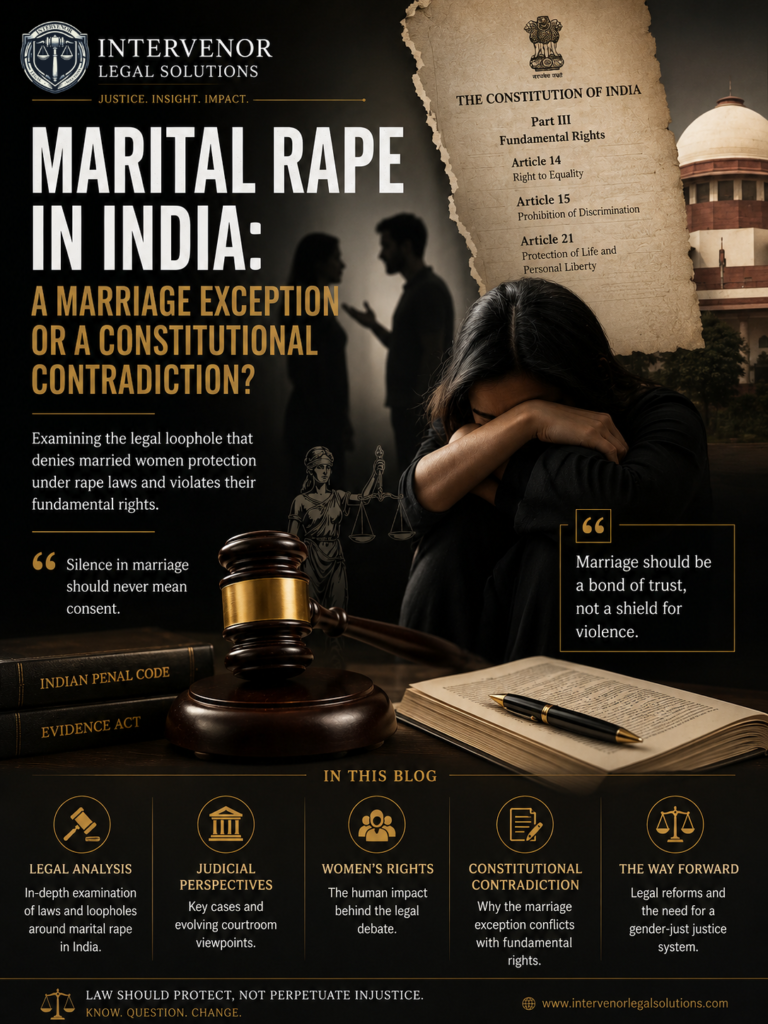
- Article 14 promises equality.
- Article 15 prohibits discrimination.
- Article 21 protects dignity, privacy and personal liberty.
So if every individual has the right over their own body, should marriage become the only exception?
Justice D.Y. Chandrachud's View
Former CJI D.Y. Chandrachud has consistently maintained that this debate isn’t about marriage.
- It’s about violence.
- It’s about bodily autonomy.
- It’s about whether marriage can ever take away a person’s right to say “No.”
- As he puts it, a woman doesn’t surrender control over her body the day she gets married.
But Why Is There Opposition?
Critics worry that criminalising marital rape could lead to misuse or affect the institution of marriage.
Supporters, however, argue something equally important—
- Criminal law is never the first option.
- Most women don’t approach courts after a single disagreement.
- They do so after repeated abuse, prolonged violence, and when every other door has closed.
What Does the World Say?
- Most countries today recognise marital rape as a crime.
- South Africa’s journey is particularly interesting.
- The law alone wasn’t enough.
- It took specialised courts, trained police officers and victim-sensitive procedures before the system truly began working.
- A law, after all, is only as strong as its implementation.
The Real Question
This debate is no longer just about one section of law.
It’s about what kind of society we want to build.
- Should marriage override consent?
- Or should consent remain meaningful, even after marriage?
Because in the end…
Marriage is a relationship.
Consent is a right.
And perhaps the real constitutional question is—
Can one ever replace the other?
Before You Leave…
Still have a question in mind?
Take a quick look at the FAQs below—you might find exactly the answers you’re looking for:
Frequently Asked Questions.
As of now, non-consensual sexual intercourse by a husband with his adult wife is generally not recognised as rape under Indian criminal law due to a statutory exception. However, this exception has been challenged before the courts, and the issue continues to be a subject of constitutional debate.
The debate centres on two competing concerns: protecting the institution of marriage on one hand, and upholding a woman’s right to bodily autonomy, dignity, and consent on the other. It raises important constitutional and social questions about equality and individual rights.
Yes. A husband can be prosecuted for offences such as domestic violence, physical assault, causing grievous hurt, cruelty, dowry-related offences, and even murder, depending on the facts of the case. The debate specifically concerns the legal treatment of non-consensual sexual intercourse within marriage.
Yes. A majority of countries across the world have criminalised marital rape, recognising that marriage does not imply permanent or irrevocable consent. However, the legal framework, procedures, and safeguards differ from one country to another.
Unlike many other criminal offences, incidents of marital rape usually occur in private, with no eyewitnesses and limited medical evidence. Courts often examine the overall circumstances, previous complaints, medical history, communication records, and patterns of abusive behaviour before reaching a conclusion.