
India’s judiciary is at a historic crossroads. For decades, the justice delivery system has struggled under the weight of delays, mounting case backlogs, and administrative bottlenecks. As of 2025, over 4.5 crore cases are pending in courts across the country a figure that underscores the urgency for innovation.
Enter AI in Indian courts a revolutionary shift where machine learning, predictive analytics, and natural language processing are becoming part of daily judicial operations. This transformation isn’t about replacing judges or lawyers; it’s about enhancing their capabilities, removing inefficiencies, and making justice delivery faster and more accurate.
The Supreme Court of India has already taken significant steps in this direction, introducing systems like SUPACE (Supreme Court Portal for Assistance in Court Efficiency), promoting virtual hearings, and encouraging AI-driven legal research.
AI in Indian Courts: How Technology Is Transforming Litigation
Artificial Intelligence is quietly becoming the silent partner of the Indian judiciary. By automating time-consuming processes like document review, translation, and evidence analysis, AI is freeing up judges and lawyers to focus on complex reasoning and nuanced arguments.
These tools are not making legal decisions they are assisting in decision-making by providing relevant precedents, summarizing large volumes of data, and ensuring no crucial detail is overlooked.
Historical Context of Technology Adoption in Indian Judiciary
The integration of technology in India’s courts isn’t new it’s been an evolving journey. The e-Courts Project launched in 2005 was the first major push toward digitization. It brought online case listings, electronic cause lists, and even video conferencing for certain hearings.
In the 2010s, courts started using case management software and introducing electronic filing. But the real acceleration happened post-2020, as the pandemic forced courts to go virtual, pushing even the most traditional legal practitioners toward technology adoption.
AI’s role began modestly primarily in legal research assistance but is now expanding to predictive analysis and workflow optimization.
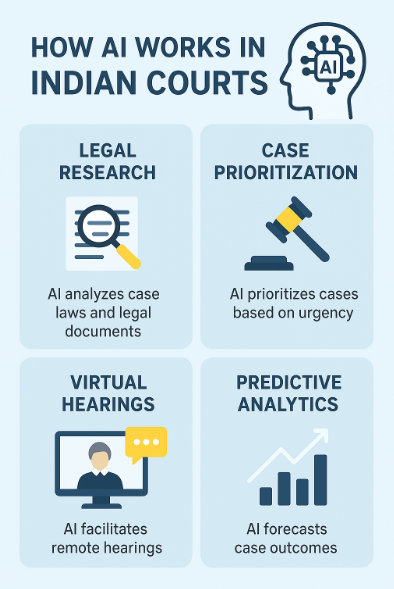
The Role of AI in Reducing Case Backlogs
One of the most critical challenges for the Indian judiciary is sheer volume. Cases can drag on for years, sometimes decades. AI can make a difference by:
- Prioritizing urgent cases based on legal criteria and urgency.
- Flagging procedural delays and suggesting solutions.
- Summarizing case files for quicker understanding.
In Maharashtra, pilot AI tools have already cut down document review time from several days to just a few hours allowing courts to hear more cases in less time.
Predictive Analytics for Case Outcomes
Predictive AI systems analyze thousands of past judgments to forecast possible case outcomes. While these predictions don’t replace judicial discretion, they can:
- Help lawyers develop stronger case strategies.
- Give litigants a realistic understanding of their chances.
- Provide data-backed recommendations for mediation or settlement.
Countries like the US, UK, and Singapore have integrated such tools for bail decisions, sentencing guidance, and risk assessments India is beginning to follow suit.
AI-Driven Legal Research and Document Review
Gone are the days when junior lawyers had to manually sift through dusty law books for precedents. AI research platforms now:
- Scan millions of legal documents in seconds.
- Highlight relevant judgments and statutes.
- Offer contextual summaries for better comprehension.
The Supreme Court’s SUPACE tool is a prime example it can process vast amounts of case law and present relevant information to judges almost instantly.
Virtual Hearings and Automated Court Scheduling
Post-pandemic, virtual hearings have become commonplace. AI is enhancing this experience by:
- Automating hearing schedules to avoid conflicts.
- Suggesting optimal timelines based on judge and lawyer availability.
- Managing courtroom resources efficiently.
This ensures reduced adjournments and faster case disposal rates.
Natural Language Processing for Multilingual Judgments
India’s linguistic diversity has often posed challenges in the legal system. AI-powered Natural Language Processing (NLP) now enables:
- Translation of judgments into multiple Indian languages.
- Real-time transcription of hearings.
- Consistency in legal terminology across translations.
This not only helps litigants understand judgments better but also increases transparency.
AI-Based Transcription and Real-Time Translation
Court proceedings can now be automatically transcribed using AI speech recognition. In multilingual cases, real-time translation ensures that all participants lawyers, clients, and judges are on the same page.
This is especially valuable in cross-border disputes and international arbitration cases.
Digital Evidence Analysis Using Machine Learning
From CCTV footage to WhatsApp chats, digital evidence is a growing part of litigation. AI can:
- Detect tampering or manipulation in media files.
- Identify faces, objects, and voice patterns.
- Link evidence across multiple cases.
This level of forensic analysis can be done faster and more accurately than manual review.
E-Filing Systems Enhanced with AI Validation
Traditional e-filing systems have been upgraded with AI, which can:
- Validate documents for completeness.
- Flag missing annexures or improper formatting.
- Suggest appropriate legal provisions based on the filing.
This reduces human error and prevents unnecessary delays.
Sentencing Guidelines Informed by AI Analytics
AI can analyze past sentencing patterns to ensure consistency and fairness. By highlighting biases or deviations, it supports judges in delivering proportionate punishments.
For example, AI could reveal if certain crimes receive harsher sentences in one state compared to another, prompting reforms.
Fraud Detection in Litigation and Arbitration
AI tools can spot suspicious litigation patterns, such as repeat filings, forged documents, or fabricated evidence. This is particularly valuable in commercial arbitration and insurance claims.
Chatbots for Legal Aid and Public Queries
AI-powered chatbots on court websites now help citizens:
- Check case status.
- Understand court procedures.
- Access basic legal guidance without hiring a lawyer.
This promotes access to justice for those who cannot afford expensive legal services.
Smart Contracts in Commercial Disputes
Smart contracts self-executing agreements coded on blockchain are increasingly being recognized in Indian arbitration. AI can:
- Verify contract conditions.
- Automatically execute payments upon compliance.
- Flag breach of terms in real-time.
Blockchain Integration for Tamper-Proof Records
Blockchain ensures that case records cannot be altered once stored. This adds an extra layer of trust to judgments, orders, and evidence storage.
AI in Witness Credibility Assessment
AI can analyze micro-expressions, speech patterns, and inconsistencies in witness testimony to flag potential dishonesty. While still experimental, this technology is gaining traction globally.
Integration of AI in Case Prioritization
AI can classify cases based on urgency, complexity, and impact ensuring that time-sensitive matters like bail hearings or medical disputes get immediate attention.
Legal Analytics for Policy and Law Reforms
By examining trends in litigation, AI can suggest areas for legal reform. For example, if data shows a surge in cybercrime cases, lawmakers can prioritize updating digital security laws.
Cybersecurity Measures for AI-Powered Court Systems
With more judicial data online, cybersecurity becomes paramount. AI-driven intrusion detection systems can monitor and prevent hacking attempts on sensitive court databases.
Ethical Concerns and Judicial Accountability with AI
While AI can enhance efficiency, there are ethical debates around:
- Bias in algorithms.
- Transparency in AI decision-making.
- Data privacy.
India must adopt strict guidelines to ensure AI assists rather than dictates judicial outcomes.
Public Perception and Trust in AI-Led Justice
For AI adoption to succeed, the public must trust it. Awareness campaigns, open trials of AI tools, and judicial transparency are key to building confidence.
Training Judges and Lawyers for AI Adoption
AI literacy is essential. The National Judicial Academy is already conducting training for judges on how to use AI-powered legal tools effectively.
Case Studies: AI in Courts Around the World vs India
Countries like Estonia are experimenting with AI “robot judges” for small claims. In contrast, India is taking a human-first, AI-assisted approach, prioritizing transparency and accountability.
The Road Ahead: AI’s Role in India’s Justice Delivery
The next decade could see AI becoming as essential to the courtroom as a gavel. With continued investment, India could drastically reduce case backlogs and deliver faster, fairer justice.
Conclusion
AI in Indian courts is not a futuristic fantasy it’s a reality in progress. While challenges around ethics, bias, and training remain, the potential benefits are undeniable. If implemented thoughtfully, AI can help India achieve a judicial system that is faster, fairer, and more accessible.

Frequently Asked Questions.
AI is used for legal research, document summarization, case prioritization, virtual hearings, and predictive analytics.
No, AI is intended to assist judges, not replace them. Decisions will remain in human hands.
Currently, SUPACE is in a pilot phase and primarily used in the Supreme Court.
Yes, by streamlining processes, prioritizing urgent cases, and speeding up research.
Yes, risks include algorithmic bias, lack of transparency, and over-reliance on automated recommendations.
Maharashtra, Delhi, and Karnataka have taken significant steps in AI-based court processes.