
Corporate governance is no longer a “good to have” it’s a “must-have” for modern companies. The Securities and Exchange Board of India (SEBI) has been at the forefront of enforcing fairness, transparency, and accountability in the corporate sector since its inception in 1992. Whether it’s protecting investors, ensuring market stability, or punishing fraudulent practices, SEBI is the watchdog that keeps corporate India in check.
Introduction to SEBI and Corporate Governance
The Securities and Exchange Board of India (SEBI) was established in 1988 and granted statutory powers in 1992 under the SEBI Act, 1992. Its primary objective? To regulate India’s securities market, protect investors, and promote fair practices.
Corporate governance refers to the set of principles, rules, and processes by which companies are directed and controlled. Good governance ensures that the interests of all stakeholders shareholders, employees, customers, and the public are protected.
What SEBI Stands For and Its Mandate
SEBI’s core mandate rests on three pillars:
- Protecting investors from fraud and misrepresentation.
- Regulating the market for fairness and efficiency.
- Promoting market development through innovation and reform.
Without SEBI, listed companies would face fewer checks, making it easier for unethical practices to go unchecked.
Overview of Corporate Governance in India
Corporate governance in India has evolved significantly, particularly after major scams like Satyam (2009). These incidents exposed the gaps in oversight and led to stricter SEBI regulations. Today, governance is not just about compliance it’s about building investor confidence and ensuring long-term sustainability.
SEBI’s Role in Corporate Governance
SEBI enforces governance norms that ensure:
- Transparency in operations through disclosures.
- Accountability of the board and management.
- Fair treatment of shareholders and stakeholders.
Its power to investigate, penalize, and enforce compliance ensures that companies take these responsibilities seriously.
Ensuring Transparency in Business Operations
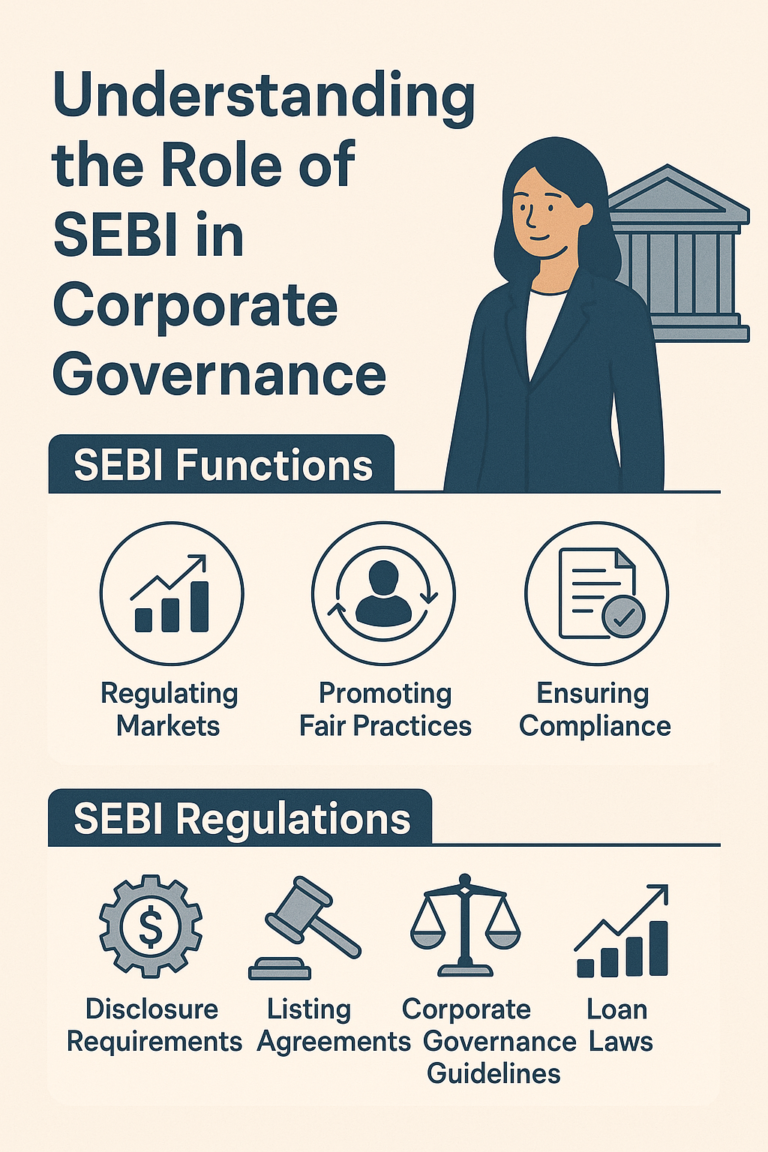
Transparency is a cornerstone of trust. SEBI mandates:
- Timely financial disclosures.
- Quarterly earnings reports.
- Related-party transaction disclosures.
For example, under SEBI’s LODR norms, companies must publish detailed results within 45 days of each quarter.
Protecting Investors’ Interests
Investors are at the heart of SEBI’s mission. This involves:
- Enforcing fair play in IPOs.
- Preventing insider trading.
- Resolving investor grievances quickly.
Platforms like SCORES allow investors to file complaints and track their resolution.
The Legal Framework of SEBI
SEBI operates under:
- SEBI Act, 1992 – Core governing legislation.
- Securities Contracts Regulation Act, 1956 – Regulates stock exchanges.
- Depositories Act, 1996 – Governs depositories and securities transfers.
Key SEBI Guidelines on Corporate Governance
Some major guidelines include:
- Clause 49 of Listing Agreement (replaced by LODR).
- Appointment of independent directors.
- Establishment of audit committees.
Corporate Governance Principles Defined by SEBI
- Accountability and Fairness – Boards must act in good faith.
- Timely and Accurate Disclosures – No hiding of material facts.
Board of Directors and SEBI’s Guidelines
SEBI insists on:
- At least 50% independent directors if the chairperson is executive.
- Separate roles for Chairperson and CEO for better checks.
Role of Audit Committees
Audit committees must:
- Oversee financial reporting.
- Monitor internal controls.
- Engage independent auditors.
SEBI’s Listing Obligations and Disclosure Requirements (LODR)
The LODR Regulations, 2015 are SEBI’s bible for corporate governance. They cover:
- Periodic disclosures.
- Corporate responsibility statements.
- Penalties for non-compliance.
Key Compliance Measures Under LODR
- Publishing shareholding patterns quarterly.
- Announcing board meetings in advance.
- Disclosure of material events within 24 hours.
Investor Protection Mechanisms by SEBI
- SCORES platform for complaints.
- Investor Awareness Programs.
- Monitoring mutual funds and brokers.
Corporate Governance in Listed Companies
For companies listed on NSE or BSE:
- Strict adherence to LODR norms.
- Independent director requirements.
- Financial transparency.
Penalties for Non-Compliance
SEBI can impose:
- Monetary fines.
- Debarment from capital markets.
- Criminal prosecution.
Case Studies of SEBI in Action
- Satyam Scam (2009) – SEBI barred Ramalinga Raju from markets for 14 years.
- PACL Ponzi Scheme – SEBI recovered ₹49,100 crore for investors.
Lessons Learned from Enforcement Cases
- Strong governance deters fraud.
- Transparency builds trust.
- Investor protection is essential for market stability.
SEBI’s Approach to Ethical Business Practices
SEBI encourages:
- ESG (Environmental, Social, Governance) reporting.
- Whistleblower policies.
Environmental, Social, and Governance (ESG) Integration
- SEBI mandates top 1,000 companies to disclose ESG metrics in Business Responsibility and Sustainability Reports (BRSR).
Impact of SEBI on Market Stability
SEBI prevents:
- Insider trading.
- Price rigging.
- Unfair mergers.
Ensuring Fair Trade Practices
- Surveillance systems to detect manipulation.
- Penalizing offenders swiftly.
Technological Advancements in SEBI’s Oversight
- AI-based fraud detection.
- Data analytics for compliance monitoring.
Future Tech-Driven Monitoring Methods
- Blockchain for transaction transparency.
- Predictive analytics for fraud prevention.
Challenges SEBI Faces in Corporate Governance
- Resistance from corporates to new norms.
- Difficulty in cross-border regulation.
Cross-Border Compliance Issues
Global companies face dual compliance burdens SEBI works to align with international norms.
The Future of SEBI in Corporate Governance
- More ESG-driven reforms.
- Greater use of AI for monitoring.
Why SEBI’s Role Matters for Businesses and Investors
Without SEBI’s oversight:
- Investor confidence would drop.
- Fraud risks would rise.
- Market stability would weaken.
Conclusion
The role of SEBI in corporate governance is more than just regulatory—it’s about shaping the ethical foundation of India’s corporate world. By enforcing transparency, accountability, and fairness, SEBI safeguards investor interests and strengthens India’s financial ecosystem for sustainable growth.

Frequently Asked Questions.
AI is used for legal research, document summarization, case prioritization, virtual hearings, and predictive analytics.
No, AI is intended to assist judges, not replace them. Decisions will remain in human hands.
Currently, SUPACE is in a pilot phase and primarily used in the Supreme Court.
Yes, by streamlining processes, prioritizing urgent cases, and speeding up research.
Yes, risks include algorithmic bias, lack of transparency, and over-reliance on automated recommendations.
Maharashtra, Delhi, and Karnataka have taken significant steps in AI-based court processes.