
Imagine a world without accountability, where leaders or powerful figures could commit atrocities and walk away freely. That was the case for most of history. But in 2002, something groundbreaking happened: the International Criminal Court (ICC) was born under the Rome Statute.
Unlike temporary courts created after specific conflicts, the ICC is a permanent institution. Its mission? To prosecute individuals accused of the most serious crimes genocide, crimes against humanity, war crimes, and aggression.
The ICC stands as a symbol of hope and justice. It tells the world: no matter how powerful you are, if you commit atrocities, you can be held accountable.
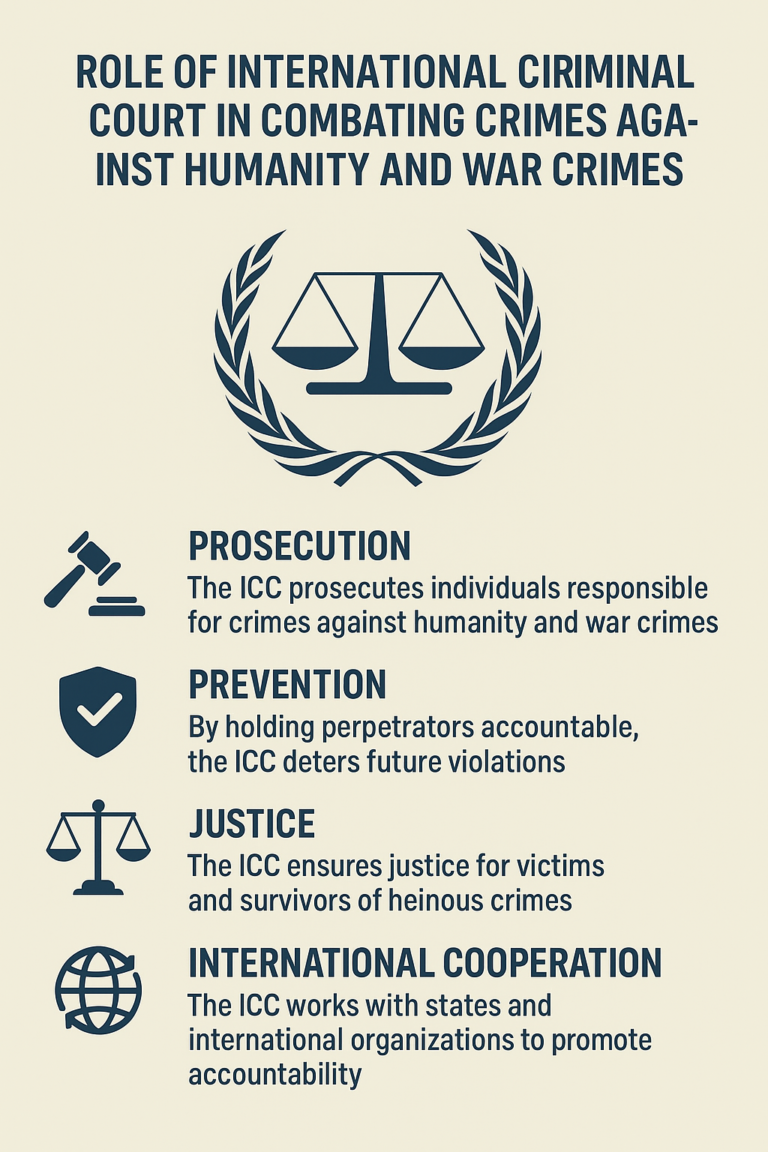
Role of International Criminal Court in Combating Crimes Against Humanity and War Crimes
The ICC plays a central role in tackling crimes against humanity and war crimes two of the worst forms of international crimes.
- Crimes against humanity include mass killings, slavery, torture, forced disappearances, and other acts carried out systematically against civilians. These are not random acts; they are calculated attacks on human dignity.
- War crimes happen during conflicts and include targeting civilians, destroying cultural sites, using prohibited weapons, or recruiting children as soldiers.
When national courts fail whether due to political pressure, lack of resources, or corruption the ICC steps in. It becomes a safety net of justice, ensuring victims aren’t silenced and perpetrators don’t escape accountability.
By prosecuting such crimes, the ICC does more than punish. It:
- Sends a warning to potential offenders.
- Provides recognition to victims that their suffering is acknowledged.
Creates historical truth, preventing denial or distortion of events.
Historical Evolution of International Criminal Justice
The ICC did not appear overnight. Its roots stretch back to World War II, when the world first demanded international accountability.
- The Nuremberg Trials (1945–46) prosecuted Nazi leaders for crimes against humanity, war crimes, and genocide.
- The Tokyo Trials did the same for Japanese war criminals.
- In the 1990s, after the genocide in Rwanda and atrocities in the Balkans, the UN set up ad hoc tribunals to bring perpetrators to justice.
These courts were temporary, but they taught the world an important lesson: justice could be global. That momentum led to the creation of the Rome Statute in 1998, which formally established the ICC in 2002.
Rome Statute: The Legal Backbone of ICC
The Rome Statute is the ICC’s foundation. Signed in 1998 in Rome, this treaty defines the crimes under ICC jurisdiction and outlines how cases are handled.
- Today, 123 countries are members.
- However, some powerful states like the United States, Russia, and China have not joined.
- The statute makes it clear that the ICC only steps in when national courts fail to prosecute.
This principle balances state sovereignty with the need for international accountability.
Crimes Against Humanity Under ICC
Crimes against humanity are among the most disturbing acts humans can commit. Under the ICC, they include:
- Murder and extermination
- Enslavement
- Deportation or forced displacement
- Torture
- Rape and sexual violence
- Persecution based on identity or belief
For example, the ICC has investigated crimes in Sudan (Darfur), Libya, and the Central African Republic, where civilians were systematically targeted.
But proving such crimes is difficult. Prosecutors must show the acts were widespread or systematic not isolated incidents.
War Crimes Under ICC Jurisdiction
War crimes strike at the very core of humanitarian principles. Under the ICC, they include:
- Targeting civilians
- Attacking hospitals or schools
- Using banned weapons
- Recruiting child soldiers
- Mistreating prisoners of war
A well-known case is the ICC’s prosecution of Thomas Lubanga from the Democratic Republic of Congo, convicted for using child soldiers. His trial showed the court’s commitment to protecting the most vulnerable children.
Landmark ICC Trials and Judgments
The ICC has handled some historic cases:
- Thomas Lubanga (DRC) – First conviction for child soldier recruitment.
- Ahmad al-Faqi al-Mahdi (Mali) – Convicted for destroying cultural heritage in Timbuktu.
- Omar al-Bashir (Sudan) – Former president indicted for genocide in Darfur (though still at large).
These cases prove the ICC’s role in holding even the most powerful accountable.
How ICC Strengthens Global Justice
The ICC does more than deliver verdicts. It:
- Promotes accountability – showing leaders they can’t act with impunity.
- Encourages peace – justice is often a step toward reconciliation.
- Supports domestic courts – many nations have reformed laws to align with ICC standards.
It’s not just about punishing crimes it’s about preventing them in the future.
Conclusion
The International Criminal Court has transformed the way the world approaches justice for the most serious crimes. By stepping in where national courts fail, it has become a guardian of accountability and a beacon of hope for victims of atrocities. From prosecuting crimes against humanity to tackling war crimes, the ICC proves that no one, not even the most powerful leaders, should be above the law.
Of course, the ICC faces challenges political resistance, lack of enforcement power, and limited membership. Yet, despite these obstacles, its very existence has reshaped global norms. It has made leaders think twice before committing crimes, given victims a voice, and established a permanent platform for international justice.
Looking ahead, strengthening the ICC’s powers, ensuring wider international support, and addressing criticisms will be crucial. But one truth remains: in a world where human rights are under threat, the ICC stands as a shield of justice a reminder that humanity will not tolerate impunity.